

THE WATCH
Expert insights on protecting your home —from humidity and salt air to smart home technology and island-specific property care.
Photo by Sebastien Gabriel
Mold Prevention in Your Kauaʻi Home — Why Prevention Is Everything
Every Kauaʻi homeowner I meet has a version of the same quiet worry. It surfaces when they open a closet after two weeks away and catch that first musty note, or when they run a hand along a cabinet interior and feel dampness that shouldn't be there. They know something is happening inside their walls. They just don't know how far along it is.
Here is the uncomfortable truth I brief every client on: by the time you can see or smell mold, prevention has already failed. Remediation is what's left — and remediation is expensive, disruptive, and frequently excluded from insurance coverage when the cause is classified as chronic humidity rather than a sudden event. On this island, where ambient humidity regularly exceeds 70%, the fight is won or lost before a single spore ever germinates.
The Numbers That Should Change How You Think
The EPA's guidance is unambiguous: mold can begin growing on damp materials within 24 to 48 hours, and indoor relative humidity should be kept below 60% — ideally between 30% and 50%. Industry restoration data adds a critical detail for us specifically: when humidity exceeds 70% and temperatures sit in the 70–90°F range, mold can germinate on damp organic surfaces within that same 24–48 hour window — no leak required. That describes an ordinary Tuesday on Kauaʻi.
Now the cost side. Professional mold remediation runs $10 to $30 per square foot, with typical residential jobs landing between $2,300 and $3,500 — and that's for contained, single-area growth. Whole-room projects involving drywall, insulation, or HVAC contamination climb fast, and reconstruction after demolition is usually a separate bill. Worse: many insurance policies cap mold coverage at $5,000 to $10,000 even when they cover it at all, and carriers routinely deny claims classified as long-term humidity or neglected maintenance. A vacant home with unmonitored humidity is the textbook definition of both.
Why Kauaʻi Homes Lose This Fight
Mainland prevention advice assumes your enemy is a water event — a burst pipe, a roof leak. On Kauaʻi, your enemy is the air itself. Mold spores are already present in virtually every home; they cannot be eliminated. What you control is whether those spores find the sustained moisture they need to activate.
The mainland homeowner's danger zone is a plumbing failure. Yours is a closed-up house between guest stays, with no air conditioning running, trade-wind moisture seeping in, and interior humidity parked above 70% for days. The EPA's 60% ceiling isn't a number Kauaʻi homes drift past occasionally — it's a threshold they live above by default unless something is actively pushing back. The highest-risk zones are the ones with no airflow: closets, cabinet interiors, the wall behind the headboard, the bathroom nobody used.
What Actual Prevention Looks Like
Prevention is not a dehumidifier you remember to empty. It is a system with three components, and I brief them in order of importance.
First, continuous measurement — by something that can act on what it reads. A basic hygrometer costs under $20 and will tell you your humidity. That's a start, but understand its limitation clearly: a hygrometer on the shelf is a gauge, not a guardian. It reports a number to an empty room. If you're on the mainland when your living room crosses 70%, that $20 device does exactly nothing about it.
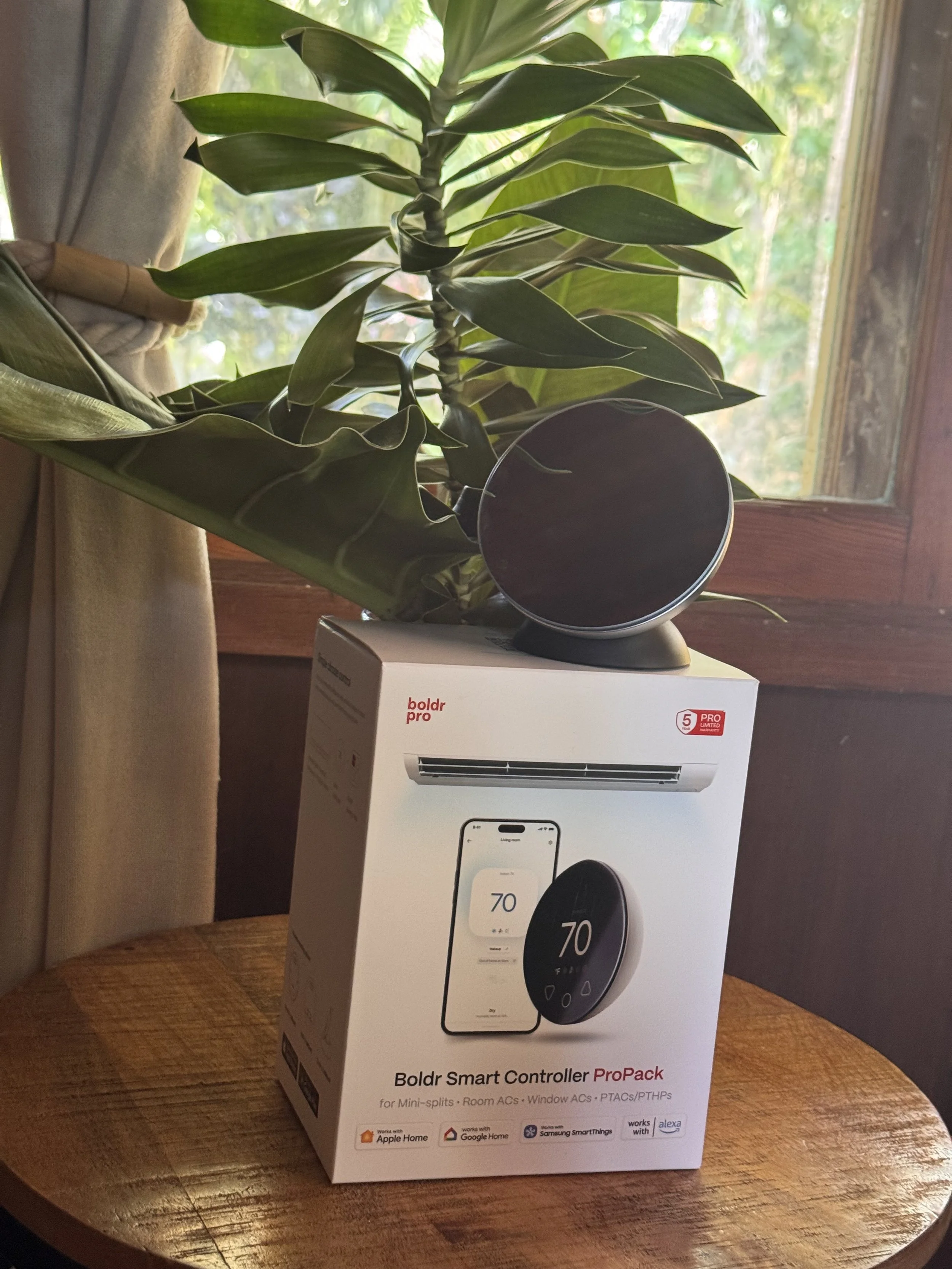
This is why the measurement layer in every property I protect is a smart climate controller — the Boldr Klima for mini-split systems, or the Ecobee SmartThermostat Premium for central AC. Both continuously monitor humidity and temperature, and this is the critical distinction: both are wired to act on what they measure. The Klima reads the ambient conditions and commands your mini-split directly. The Ecobee adds built-in air quality and occupancy sensing on top of its humidity monitoring, feeding multi-room data from its included SmartSensor. Either way, the device watching your humidity is the same device controlling the equipment that can fix it. Measurement and response in one unit — no gap between knowing and doing.
Second, automated response thresholds. When humidity crosses 65%, something must act within hours, not when you next visit the island. The Klima activates Dry Mode automatically at that threshold — running your mini-split in dehumidification mode, which removes moisture at a fraction of full-cooling energy cost. The Ecobee executes the equivalent response on central systems and flags temperature or humidity anomalies that suggest an HVAC failure in progress. Both do this at 2 a.m. on a Tuesday whether you're in Poʻipū or Portland, and both continue executing locally even when your internet doesn't cooperate — because on this island, the storm that spikes your humidity is often the same storm that takes down your WiFi.
Third, documentation. Every reading the Klima or Ecobee takes flows into a continuous log — in my clients' case, a 52-week record delivered in weekly written reports. That documentation is the difference between an insurance adjuster classifying your claim as a sudden covered event versus denied chronic neglect. If a dispute ever comes, the owner with timestamped data wins.
Twenty-four years of submarine service taught me that casualties prevented cost almost nothing, and casualties discovered cost everything. Mold obeys the same law.
If you don't currently know what your home's humidity did last week, that is the gap — and it's closable. Schedule a Systems Audit and I will personally assess every moisture risk point in your home, measure your baseline conditions, and hand you a written report before any work begins. No obligation beyond the audit itself.
The spores are already in your house. Whether they ever matter is up to you.
— Matthew Hart
Senior Chief Petty Officer, USN (Ret.) | Anchor Point Kauaʻi
(808) 631-6980 | anchorpointkauai.com
The Real Cost of an Undetected Water Leak in Your Vacant Hawaiʻi Home
There is a specific kind of dread that comes with owning a vacant home across an ocean. You lock the door, fly back to the mainland, and somewhere in the back of your mind a question sits unanswered: what is happening inside that house right now? For most owners, the honest answer is that they have no idea — and the most expensive problem a vacant home can develop is the one nobody is there to see.
A water leak in an occupied home announces itself. Someone hears the drip, sees the stain, feels the soft spot in the floor. A water leak in a vacant home on Kauaʻi announces nothing. It runs silently — for days, weeks, sometimes an entire booking gap — and by the time your cleaner or property manager opens the door, the problem has matured from a repair into a remediation.
What the Numbers Actually Say
I don't deal in scare tactics. I deal in data, so here is the data.
The average U.S. homeowners insurance claim for water damage and freezing was $13,954 between 2018 and 2022, according to the Insurance Information Institute. Water damage accounted for roughly 24–28% of all homeowners insurance claims in recent years — the second most common claim category after wind and hail. The National Association of Insurance Commissioners estimates water damage costs insurers approximately $13 billion per year.
Now consider the vacant-home multiplier. FEMA reports that just one inch of standing water can cause up to $25,000 in damage. That figure assumes someone responds. In an unoccupied Kauaʻi property, a failed supply line can run unchecked for two weeks. The EPA notes that hidden leaks alone waste nearly 10,000 gallons of water per household annually — and those are the slow ones nobody notices even when they're home.
The damage does not stop at the repair bill. Guardian Service's analysis of Insurance Information Institute (III) data found the average premium after filing a water damage claim rises to $3,106 — about $180 above the national average — and that increase follows you for years.
The Vacancy Problem Insurance Companies Don't Advertise
Here is the part every off-island owner needs to understand clearly: gradual water damage is frequently not covered. Standard homeowners policies cover sudden, accidental events — the pipe that bursts. What they routinely deny is damage an insurer classifies as gradual or resulting from "lack of reasonable maintenance," per ConsumerAffairs' review of industry claims data.
A slow leak that ran for three weeks in your vacant home sits squarely in that gray zone. The insurer's question will be simple: why didn't anyone catch it? If your answer is "nobody was watching," you may be absorbing that $13,954 average — or far worse — entirely out of pocket.
And on Kauaʻi, water damage never travels alone. Mold begins growing on wet materials within 24 to 48 hours according to industry restoration data — and that clock runs faster in our ambient humidity, which regularly exceeds 70%.
Why Detection Speed Is the Entire Game
The difference between a $500 cleanup and a $40,000 remediation is almost never the size of the leak. It is the duration. Fewer than 20% of homeowners take any precautionary steps against water damage, per a Triple-I consumer survey — and while 84% of homes have smoke detectors, only 17% have a water sensor of any kind.
Submarine service taught me that casualties are survivable when they are detected early and acted on immediately. The same principle governs your home. A leak sensor at the water heater, paired with an automated shutoff valve on your main line, converts a multi-week disaster into a sixty-second event: water detected, valve closed, owner notified. The leak still happened. The damage didn't.
Your vacant home should not be a question mark in the back of your mind. It should be a known quantity — monitored, documented, and defended whether you are on island or 3,000 miles away.
If you own property on Kauaʻi and cannot say with certainty what your water lines did last week, start with a Systems Audit. I will assess every risk point in your home and hand you a written report before any work begins.
The data is clear. The gap is detection. Close it.
— Matthew Hart
Senior Chief Petty Officer, USN (Ret.)
Anchor Point Kauaʻi | anchorpointkauai.com | (808) 631-6980
The Hidden AC Energy Waste Draining Your Kauaʻi Vacation Rental — And How to Stop It
Running a vacation rental on the Garden Isle is a labor of love, but the monthly KIUC bill can quickly turn that love into a financial headache. With Kauaʻi's electricity rates among the highest in the country, every hour a guest leaves the split-system cranking at 60°F while they're out exploring the Napali Coast is money straight out of your pocket.
For many owners in Poʻipū or Princeville, the challenge has always been the tech: how do you manage a ductless mini-split without a complicated, invasive install? I spent 24 years aboard nuclear submarines learning that the most expensive problems are the ones no one is watching. AC energy waste in an unmonitored vacation rental is exactly that — a slow, invisible drain that compounds every single month you're not paying attention.
Why Your Split-System Is Costing More Than It Should
A standard ductless mini-split in continuous operation uses between 500 and 1,000 watts per hour. At KIUC's current rate of $0.4086 per kilowatt-hour — 144% above the national average — a unit running 16 hours a day in an unoccupied property costs roughly $196 per month in electricity alone. That's one zone. A three-bedroom property in Princeville with three zones running unmanaged can quietly burn through nearly $600 a month before anyone notices.
The problem isn't the equipment. Mini-splits are efficient machines when managed correctly. The problem is that without smart controls, they operate on a binary logic: someone set a temperature, and they're going to hold it whether your guest left two hours ago or two days ago. Kauaʻi's humidity compounds the issue further. A unit running continuously in dry mode to combat 75% ambient humidity is doing necessary work — but only if it's doing it intelligently, not reflexively.
What Smart Climate Control Actually Does
The Boldr Klima system I install at Anchor Point Kauaʻi properties doesn't replace your existing mini-split — it gives it a brain. Using WiFi integration and Home Assistant automation, it learns occupancy patterns and responds to real environmental conditions rather than a guest's last thermostat setting.
In practical terms, this means the system activates Dry Mode automatically when indoor humidity exceeds your set threshold — typically 65% — and scales back when conditions normalize. Between guest stays, it maintains a protective baseline rather than a comfort temperature. During peak occupancy, it responds to actual heat load rather than a fixed setpoint. The result, based on documented runtime reduction from 16 hours daily to approximately 10 hours, is a conservative energy savings of $73 per zone per month at KIUC rates. On a three-zone property, that's over $2,600 annually — back in your pocket.
The Bigger Picture: Protecting Your Equipment and Your ROI
AC energy waste isn't just a utility bill problem. It's an equipment longevity problem. A mini-split running unnecessary hours in Kauaʻi's salt air environment accumulates corrosion on coils, degrades compressor cycles, and shortens the unit's rated service life. The same humidity that makes smart climate control financially valuable also makes it essential for asset protection.
This is the discipline I carried from submarine systems management into home protection: you don't wait for a system to fail to know it's running wrong. You read the data, you set the thresholds, and you let automation handle the correction before inefficiency becomes damage. A unit that runs 30% fewer hours doesn't just save electricity — it saves the $3,000 to $6,000 coil replacement cost that salt air corrosion eventually demands from every unprotected Kauaʻi property.
Combined with quarterly ACF-50 anti-corrosion treatment, which is included in every Guardian and Commander monitoring plan, smart climate management extends equipment life measurably. The math closes fast. The question is simply how long you want to keep paying for inefficiency before you address it.
Every property I assess has a version of the same story: systems running when they shouldn't be, humidity unchecked during gaps between guests, and utility bills accepted as an unavoidable cost of doing business on the island. They are not unavoidable. They are a solvable problem.
If you want to know exactly what your property is spending — and what it could be saving — start with a $149 Systems Audit. I'll walk through your specific configuration, identify the waste, and give you a written plan before any work begins. Your audit fee applies in full toward your first month of service if you choose to move forward.
The math is on your side. So is the technology.
— Matthew Hart USN (Ret.) Anchor Point Home Services, Kauaʻi HI
Why Kauaʻi Humidity Is Your Vacation Home's Biggest Enemy
I've spent 24 years in environments where ignoring a threat wasn't an option. Aboard a fast attack submarine, every system is monitored continuously — not because problems are expected, but because the cost of missing one is too high. That same principle is what brought me to Kauaʻi home protection, and it's what I want to share with you today.
If you own a vacation home on Kauaʻi, you already know the island is extraordinary. What you may not fully appreciate — especially if you're managing your property from the mainland — is that Kauaʻi's environment is working against your investment every single day you're not there. And the biggest threat isn't the occasional storm. It's the humidity you can't see, can't smell, and won't notice until the damage is already done.
What Kauaʻi Humidity Actually Does to a Home
Kauaʻi averages between 70% and 85% relative humidity year-round — significantly higher than most mainland climates. At those levels, moisture doesn't just hang in the air. It infiltrates. It works its way into wall cavities, cabinet interiors, crawl spaces, and subfloors. It condenses on surfaces that warm and cool with the daily temperature cycle. Over time it creates the conditions that wood rot, mold, and structural deterioration need to take hold.
The problem for vacation homeowners is timing. Your property sits unoccupied for weeks or months at a time. The air conditioning that normally helps manage humidity isn't running continuously. Windows stay closed. Air doesn't circulate. What was a manageable humidity level when you left becomes an unchecked environment that compounds daily. By the time you return — or worse, by the time a guest checks in and reports a problem — the damage has already been building for weeks.
The Salt Air Multiplier
Humidity alone is damaging enough. But on Kauaʻi, humidity doesn't travel alone. Salt air from the ocean carries microscopic chloride particles that deposit on every exposed surface — metal fixtures, electrical connections, appliance components, door hardware, and HVAC systems. When combined with high humidity, those chloride deposits accelerate corrosion at a rate that would surprise most mainland homeowners.
I've walked through properties where door hinges had seized within two years of installation, where electrical junction boxes showed advanced corrosion, and where HVAC coils had degraded to the point of failure — all in homes that looked perfectly fine from the outside. Salt air corrosion is invisible until it becomes a replacement cost, and on Kauaʻi it operates on a timeline that punishes absentee ownership.
Why Standard Property Management Isn't Enough
I want to be clear about something — property managers do an important job. They handle guests, coordinate maintenance, and keep your rental calendar running. But their job is not to monitor your home's environmental conditions continuously. It's not to track humidity levels in your master closet at 2am on a Tuesday. It's not to cross-reference your HVAC performance data against the week's weather pattern.
That's a different discipline entirely. It's the discipline of systems monitoring — the same discipline applied to keeping a submarine operational in an environment that wants to destroy it. What your Kauaʻi vacation home needs isn't just someone to check on it occasionally. It needs continuous environmental intelligence, automated response when conditions exceed safe thresholds, and a trained eye that knows what early stage damage looks like before it becomes a five-figure repair bill.
The good news is that the technology to protect your home exists, it's deployable on Kauaʻi, and it doesn't require you to be on the island to benefit from it. A Systems Audit is where we start — a thorough walkthrough of your property that identifies your specific vulnerabilities and builds a protection plan around them. The audit costs $149 and is credited in full toward your first month of monitoring service if you choose to proceed.
If you own a vacation home on Kauaʻi and you haven't had a professional environmental assessment, the humidity is already ahead of you. The question is how far.
— Matthew Hart Owner, Anchor Point Home Services, LLC